States of Matter
Term 1 - 2026
Course learning objectives
- Explain how experimental evidence (diffusion, osmosis) supports the particulate theory of matter
- Distinguish among the three states of matter in terms of particle arrangement, energy and forces of attraction
- Explain changes of state (melting, evaporation, boiling, condensation, freezing, sublimation) in terms of energy and particle arrangement
- Interpret heating and cooling curves
States of Matter
Four lessons covering the particulate theory of matter, evidence from diffusion, the three states of matter, and changes of state.
L1 · Evidence for the Particulate Theory of Matter — Diffusion in Liquids4 content · 0 resources
Lesson objectives
- Give a definition of matter
- State the four main ideas of the particulate theory of matter
- Explain why scientists find the particulate theory of matter useful
- Explain how the diffusion of a solid in a liquid provides evidence for the particulate theory of matter
Syllabus objectives covered
- 1.1 — explain how evidence supports the particulate theory of matter
Hook: The Mystery Smell
Why can you smell food cooking from another room, or a friend's perfume from across the classroom, even though nothing visible seems to be moving through the air? By the end of today's lesson you'll be able to explain this using the particulate theory of matter.
The Particulate Theory of Matter
Matter is anything that has mass and occupies space. Scientists explain the properties and behaviour of matter using the particulate theory of matter, which states that:
- all matter is made of particles
- the particles are in constant, random motion
- there are spaces between the particles
- there are forces of attraction between the particles
This theory is useful because it lets us explain both the physical properties of matter and the differences between the three states of matter.
Demonstration: Diffusion of Potassium Manganate(VII) in Water
Method: Place a straw vertically in a beaker of distilled water until it touches the bottom. Drop a crystal of potassium manganate(VII) into the straw without moving it, then carefully remove the straw, disturbing the water as little as possible.
Observation: The purple colour immediately begins to spread from the crystal. Left for a few days, the purple colour spreads throughout the whole beaker of water.
Explanation: The crystal and the water are both made of minute particles. The particles in the crystal are packed closely together; those in the water have small spaces between them. As the crystal dissolves, its particles slowly separate and diffuse into the spaces between the water particles until they are evenly distributed. This is evidence that particles are able to move, and that there are spaces between particles.
Quick Check: Evidence for Particles
I. Osmosis
II. Decomposition
III. Diffusion
L2 · Diffusion in Gases — Ammonia and Hydrogen Chloride5 content · 0 resources
Lesson objectives
- Describe a practical experiment that demonstrates diffusion in gases
- Explain the observations of the ammonia/hydrogen chloride diffusion experiment in terms of particle movement and particle mass
- Use the results of gas diffusion experiments as evidence for the particulate theory of matter
Syllabus objectives covered
- 1.1 — explain how evidence supports the particulate theory of matter
Recap: Diffusion in Liquids
Last lesson, a potassium manganate(VII) crystal dropped into water spread its purple colour throughout the beaker — evidence that particles move and that there are spaces between them. Today we test whether gases diffuse the same way.
Practical: Diffusion of Ammonia and Hydrogen Chloride Gases
Method:
- Place a glass tube at least 1 m in length between two retort stands.
- Soak separate pieces of cotton wool in concentrated ammonia solution and concentrated hydrochloric acid.
- Place them simultaneously at each end of the glass tube.
- Seal the ends of the tube with rubber stoppers.
- Allow time for the ammonia and hydrogen chloride vapours to diffuse. Observe any changes.
Observation: A white solid ring forms inside the tube — but not exactly in the middle. It forms closer to the hydrochloric acid end.
Reaction Forming Ammonium Chloride
Why Does the Ring Form Off-Centre?
The ammonia and hydrogen chloride particles diffuse through the air in the tube towards each other and react on contact to form solid ammonium chloride. Ammonia particles are lighter than hydrogen chloride particles, so they move faster through the air. This means the ammonia particles cover more distance before meeting the hydrogen chloride particles, so the white ring forms closer to the hydrochloric acid end of the tube.
Quick Check: Gas Diffusion
L3 · The Three States of Matter — Properties & Classification4 content · 0 resources
Lesson objectives
- Distinguish among the three states of matter in terms of shape, volume, density and compressibility
- Explain differences among the three states in terms of particle arrangement, forces of attraction and particle energy
Syllabus objectives covered
- 1.2 — distinguish among the three states of matter
Hook: Squeeze Test
Try (mentally!) squeezing an ice cube, a cup of water, and a balloon full of air. Which one changes volume most easily? Why do you think that is?
Particle Arrangement and Energy in the Three States
Physical properties — shape, volume, density, compressibility, solubility, melting point and boiling point — can all be explained using the particulate theory:
- Solids have a fixed shape and fixed volume because their particles are packed closely together in a regular pattern and cannot move out of their fixed positions; they are very difficult to compress. Forces of attraction between the particles are strong, and particles have very little energy — they simply vibrate in place.
- Liquids flow and take the shape of their container, but keep a fixed volume, because their particles have small spaces between them and can move past one another. Liquids can be compressed slightly. Forces of attraction are weaker than in a solid, and particles have moderate energy — they move about slowly.
- Gases take the shape and volume of their container because their particles move freely and rapidly, with large spaces between them and only weak forces of attraction. Gases are easy to compress and generally have a much lower density than solids or liquids.
Match & Sort: Properties of Solids, Liquids and Gases
5-Question Quiz: States of Matter
L4 · Changes of State — Melting, Boiling, Condensation, Freezing & Sublimation6 content · 3 resources
Lesson objectives
- Explain the changes of state (melting, evaporation, boiling, condensation, freezing, sublimation) in terms of energy and arrangement of particles
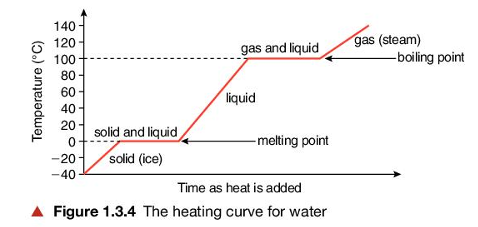
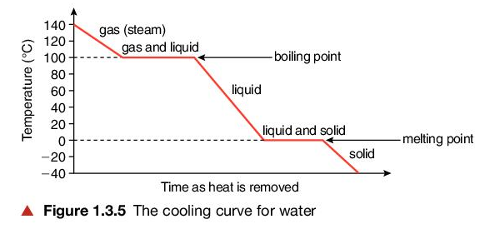
- Understand and interpret heating and cooling curves
- Explain the difference between boiling and evaporation
Syllabus objectives covered
- 1.1 — explain how evidence supports the particulate theory of matter
- 1.2 — distinguish among the three states of matter
- 1.3 — explain the changes between the three states of matter in terms of energy and arrangement of particles
Hook: Solid, Liquid or Gas?
Hot chocolate steaming, a glass of water, an iced drink with ice cubes floating in it: three states of the same substance side by side. What decides which state water is in at any given moment?
Melting, Evaporation, Boiling, Condensation, Freezing and Sublimation
A change of state is a physical change caused by a change in temperature, which changes the kinetic energy of the particles:
- Melting — a solid changes to a liquid at its melting point, as particles gain enough energy to overcome the forces holding them in fixed positions.
- Evaporation — particles near the surface of a liquid gain enough energy to escape as a gas; this can happen at any temperature and cools the remaining liquid.
- Boiling — a liquid changes to a gas throughout the liquid at a fixed temperature, the boiling point.
- Condensation — a gas changes to a liquid as particles lose energy and move closer together.
- Freezing — a liquid changes to a solid at its freezing point (the same temperature as its melting point for a pure substance).
- Sublimation — a solid changes directly to a gas (or a gas directly to a solid) without passing through the liquid state, because the forces of attraction between particles are weak.
During melting and boiling, the temperature stays constant while heat is still being supplied, because all the added energy is being used to overcome the forces of attraction between particles rather than to increase their speed.
Heating Curve for Water
Cooling Curve for Water
Sublimation in Everyday Life
Substances with weak forces of attraction between their particles can sublime — changing directly between solid and gas without becoming liquid. Everyday examples include:
- Solid carbon dioxide ('dry ice'), used to keep things cold without leaving a liquid residue
- Naphthalene mothballs/camphor balls, which slowly sublime to release their smell
- Iodine, which sublimes to a purple vapour when gently heated and re-forms as crystals when cooled
- Solid air fresheners, which sublime to release fragrance into a room
Coming Up: Heating & Cooling Curve Assessment
A separate assessment quiz on reading and interpreting heating and cooling curves will follow this lesson. Review today's graphs and complete the worksheet questions carefully — they cover exactly the skills that quiz will test (identifying states, reading off melting/boiling points, and explaining the flat sections in terms of particle energy).